Why Basement Windows Leak in Heavy Rain: Window Leak Repair Triage Guide
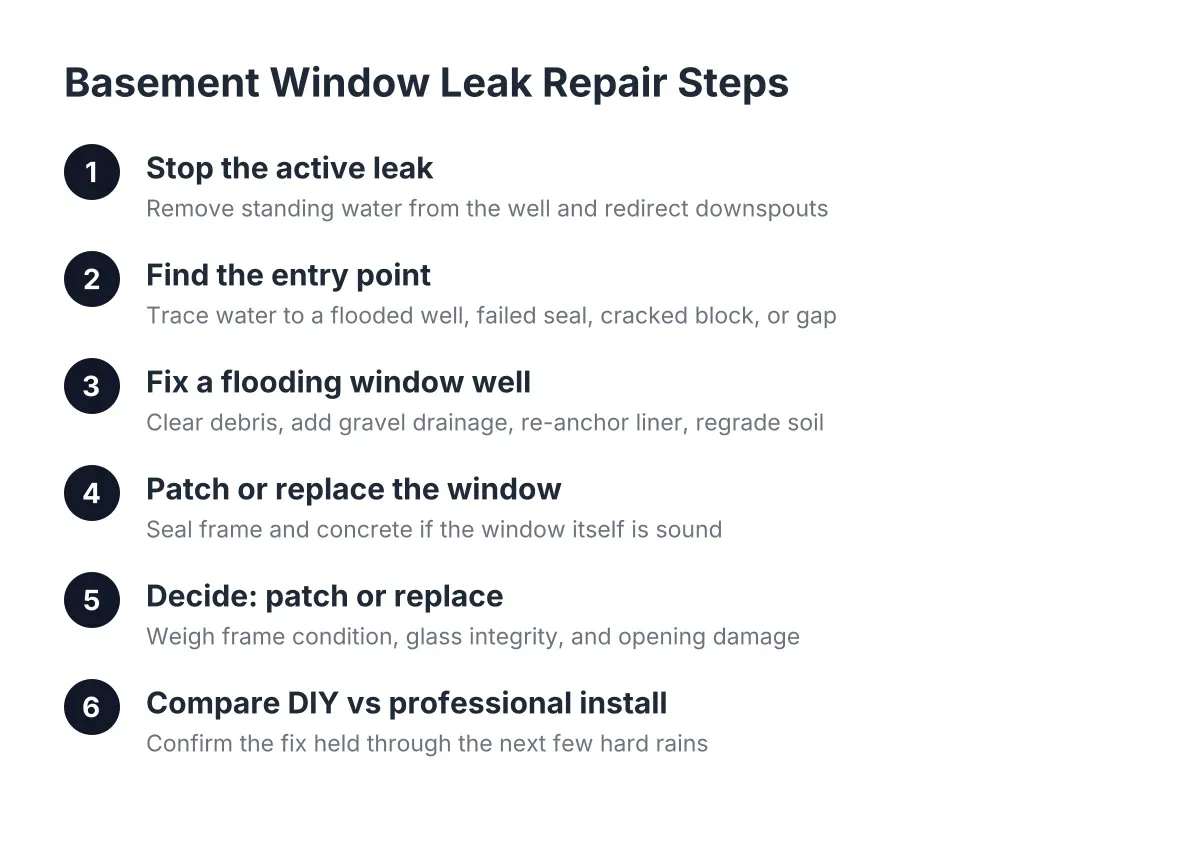
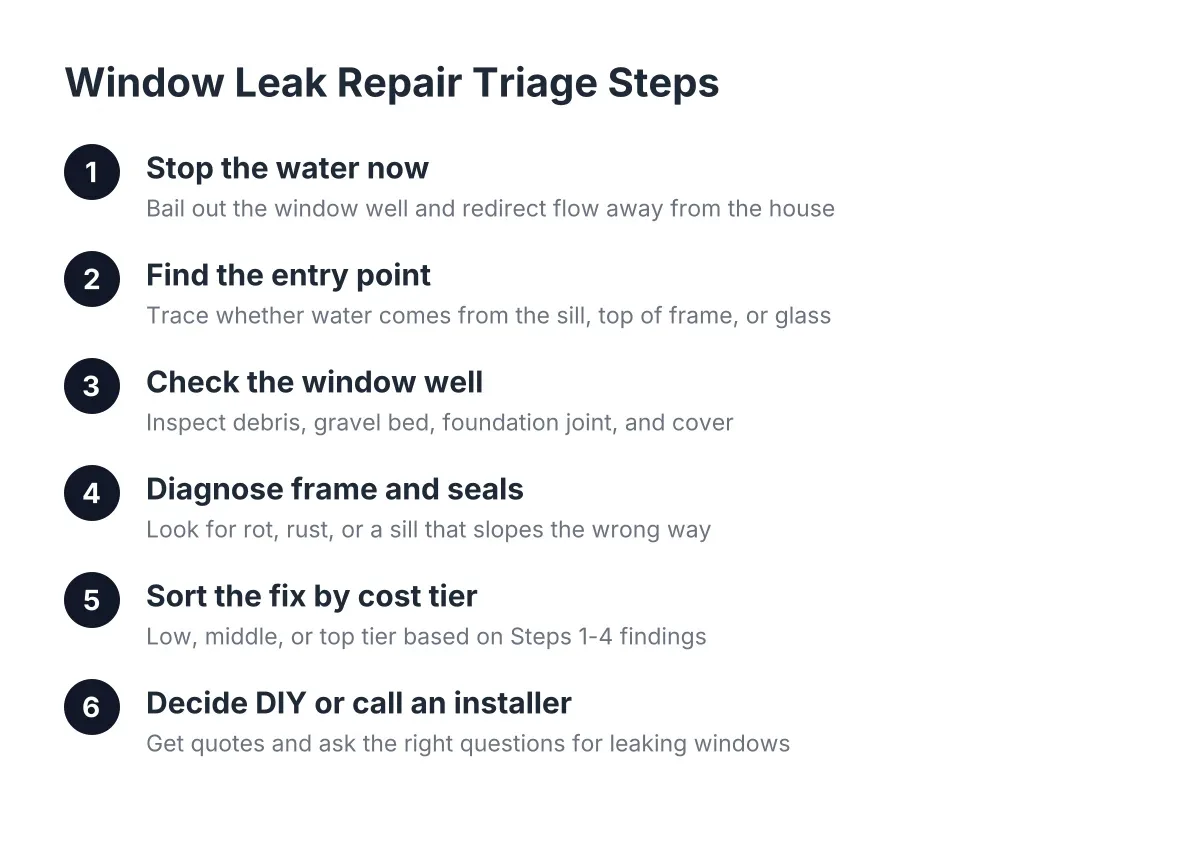
Water is coming in at the basement window and rain is still falling. You need window leak repair answers fast: is this a small caulk-and-drainage fix, or a full basement window replacement that a buyer's inspector will demand before closing? This guide walks you through the triage in order. Follow the steps and you will know within an hour whether you are looking at a cheap fix, a window well problem, or a failed window that needs a local installer.
Most basement window leaks during heavy rain come down to one of three things: water pooling in the window well, failed sealant or seals around the frame, or grading that pushes roof and surface water toward the foundation. The steps below sort out which one you have.
Step 1: Stop the Water Coming In Right Now
First, deal with the active leak before you diagnose anything. Move stored items, rugs, and furniture away from the window. Put down towels and a shallow pan or bucket to catch the drip. If water is pouring in fast, a shop vac keeps it from spreading across the floor.
Next, go outside with a flashlight, even in the rain. Look down into the window well. If you see standing water rising against the glass, that is your problem. Bail it out with a bucket or pump it with the shop vac. Getting the water level below the bottom of the window frame usually stops the leak within minutes.
If there is no window well and the window sits at or near grade, check whether a downspout, a low spot in the yard, or a saturated flower bed is feeding water straight at the window. Redirect the downspout with a temporary extension if you can do it safely.
Step 2: Find Where the Water Is Actually Entering
Once the flow slows, trace the entry point. Where the water shows up tells you what kind of repair you need.
- Water pooling at the bottom of the frame or the sill: usually a flooded window well or failed sealant at the bottom joint.
- Water dripping from the top of the window frame: often water running down the foundation wall from bad grading, a gap where the well meets the house, or a failed joint between the frame and the masonry above.
- Water seeping through the glass area on an old block window: glass block or steel-frame windows from before 1990 often have cracked mortar joints or rusted frames that let water through the assembly itself.
- Damp concrete around the whole opening: the leak may be through the foundation wall near the window, not the window itself.
Water dripping from the top of a window frame confuses a lot of homeowners because the instinct is to blame the window. In a basement, it more often means water is getting behind the window well or running down the wall from above, then finding the first gap it can.
Step 3: Check the Window Well and Its Drainage
A window well that holds water is the most common reason basement windows leak during heavy rain in Minneapolis. The well is supposed to hold soil back and let water drain down through gravel at its base. When that drain path clogs, the well fills like a bucket and the window becomes a dam.
Check these four things:
- Debris. Leaves, mulch, and sediment on the well floor block drainage. Scoop it out down to the gravel.
- The gravel bed. If you dig a few inches and hit packed clay instead of gravel, the well never had proper drainage installed. Minneapolis clay soil holds water, so this matters more here than in sandy regions.
- The well-to-foundation connection. The well should sit tight against the house with a continuous sealed joint. If it has pulled away, water runs behind it and straight down the wall to the window. Frost heave does this to older wells over time; our freeze-thaw cycles push wells away from the foundation a little more each winter.
- The cover. A missing or cracked well cover lets rain and roof runoff fall directly into the well. A fitted cover with a bead of caulk around its edge keeps most rainwater out of the well entirely.
If the well itself is rusted through, collapsing, or separated from the house, cleaning will not fix it. Window well replacement costs an average of $2,200, with most homeowners spending between $1,800 and $3,000, according to HomeAdvisor. A galvanized well installed with proper gravel and a sealed joint against the foundation is the durable version of this fix.
Step 4: Diagnose Window Leak Repair Needs at the Frame and Seals
With the well ruled in or out, look at the window itself. Run your hand around the interior frame after the rain stops. Soft or crumbling wood, rust stains on a steel frame, or daylight visible at the edges all point to seal failure or a frame past its life.
Outside, check the sealant joint between the window frame and the surrounding concrete or masonry. On older homes this joint was mortared once and never touched again. Cracked or missing sealant here is a direct water path, and it is the classic cause of basement window seal failure.
Also check the sill. The bottom board of a basement window frame should slope slightly outward so water drains away from the opening. If the sill is flat or tilts inward, water that lands on it during a storm runs toward the house instead of away. That is an installation defect, and caulk alone will not correct it for long.
This is the fork in the road for addressing leaks. Sealant failure on a sound frame is a DIY-range fix. A rotted, rusted, or badly installed frame means replacement, because new caulk on a failed frame is the kind of patch that fails again by the next spring thaw.
Step 5: Sort the Fix by Cost Tier
Here is the triage answer a homeowner under a closing deadline actually needs. Basement window leaks fall into three cost tiers, and Steps 1 through 4 tell you which one you are in.
The low-cost tier: sealant, covers, and drainage cleanup
If the frame is sound and the well drains once cleaned, you are in the cheapest tier. The work is exterior sealant around the frame, a bead of polyurethane sealant where the well meets the foundation from bottom to top, a fitted well cover, and downspout extensions. A capable homeowner can handle most of this in a weekend. A window leak repair kit from a hardware store covers the sealant portion, though skip the cheap latex caulk; exterior-grade polyurethane holds up to Minnesota freeze-thaw cycles far better.
The middle tier: window well installation or replacement
If the well is failing but the window is fine, you are replacing or installing a well. That means excavating around the opening, setting a new galvanized well, adding a gravel drainage bed, sealing the well to the foundation, and grading the backfill so surface water runs away from the house. Installing a window well runs from $500 to $1,500 or more depending on the situation, according to Angi.
The top tier: basement window replacement or an egress upgrade
If the window itself has failed, or an inspector flagged it, you are in replacement territory. Old glass block and steel-frame block windows often cannot be repaired in any lasting way; the fix is a new unit set level and sealed correctly. Correct leveling matters more than most homeowners realize, because a window installed out of level leaks air and water no matter how much caulk goes around it.
In addition, if the basement has a finished bedroom or you plan to sell it as one, code compliance enters the picture. Minnesota follows the bedroom egress requirement based on the IRC: the window needs a minimum net clear opening of 5.7 square feet, and the well must project at least 36 inches from the house with a nine-square-foot footprint, according to HomeAdvisor. Installing an egress window costs an average of $4,229, with most homeowners spending between $2,723 and $5,877, per HomeAdvisor. Adding an egress window and well together runs about $3,900 on average, according to Angi.
Step 6: Decide Whether to DIY or Call a Local Installer
Use a simple rule. If the fix is sealant, a cover, or clearing debris, do it yourself this week. If the fix involves excavation, setting a well, cutting or enlarging an opening in the foundation, or meeting an egress requirement, get a local installer who works in Minneapolis soil and frost conditions. Foundation cuts and drainage grading are not forgiving of guesswork, and a bad well install just moves the leak.
For example, suppose a homeowner in south Minneapolis gets an inspection report three weeks before closing that flags a rusted steel basement window with water staining below it. In that scenario, the smart move is to get a written quote for basement window replacement in the first few days, not to spend two weekends on caulk that the buyer's inspector will reject at the walk-through. A documented quote also caps the negotiation; without one, the buyer's repair credit request is a guess that tends to run high.
One honest caution: if you see water coming through the foundation wall itself, or the basement floods from multiple points, the window may not be the main problem. That situation calls for a drainage or waterproofing evaluation before anyone touches the window, because replacing a window next to a failing foundation wall fixes the wrong thing.
What to Ask When You Get Quotes for Leaking Windows
Quotes for the same leaking basement window can vary widely, and as of 2026 that has not changed. The spread usually comes from scope, not markup. One contractor is quoting caulk; another is quoting a new well, gravel, grading, and a window. Ask each bidder these questions so you compare the same job:
- What exactly is failing, the seal, the well, the drainage, or the window itself?
- Does the quote include a new well, gravel drainage bed, and sealing the well to the foundation?
- Will the finished window meet the egress requirement if this room is, or will be, a bedroom?
- How will you grade the backfill so water runs away from the opening?
- Is the quote itemized in writing, with a timeline that works before my closing date?
Leaking windows during heavy rain are a symptom. The right contractor names the cause before naming the price. If a bidder cannot tell you why the window leaks, keep calling. A clear diagnosis, an itemized quote, and a fix matched to the actual failure will get you dry, closed, and done without paying for work you did not need.
If you need basement egress window installation, Minneapolis Window Pros can help.
Prefer to talk it through? Call (612) 482-9787 — a quick call is usually the fastest way to get a straight answer for your situation.