
Basement Window Leaks — Complete Guide
Water is coming in around a basement window, and you need answers before the next storm. This guide covers why basement windows and window wells leak, what the fix actually costs, and how to tell a $200 caulk job from a $3,000 replacement. You will also learn when a bucket-and-towel fix is enough and when it is time to search for window repair near me and get a real contractor on site. We work on basement and egress windows across Minneapolis every week, so this page reflects local soil, frost, and drainage conditions, not generic national advice. Read it now, then use the linked guides below to go deeper on your specific situation.
What You'll Find in This Guide
- Why Basement Windows Leak in Heavy Rain: Window Leak Repair Triage Guide
- Basement Window Leak Repair: When to Patch and When to Replace the Window
- Window Leak Repair Cost: What Really Drives the Price?
- Basement Window Leaks Terms Explained: A Plain-English Glossary
Why Basement Windows Leak After Heavy Rain
Basement windows sit at the lowest, wettest point of your house. When a leak shows up after a storm, one of four causes is almost always behind it.
The most common cause is a flooded window well. A window well is a dug-out pit that lets light reach a below-grade window. If the drain at the bottom clogs with leaves, silt, or ice, the well fills like a bathtub. Once water rises above the window sill, it pours through the frame regardless of seal quality.
The second cause is grading and gutters. Soil sloping toward the house sends roof and surface water at the foundation. A downspout dumping next to a window well can overwhelm it in minutes. These are drainage problems, and fixing the window alone won't solve them.
The third cause is seal failure. Caulk shrinks, glazing cracks, and steel frames rust through. Minneapolis freeze-thaw cycles are brutal on sealants—a bead that looked fine in September can split by March. Basement window seal failure usually shows as a slow trickle at frame edges rather than fast-rising water.
Finally, hydrostatic pressure can push water through gaps between the window frame and foundation. Saturated soil presses against the wall, forcing water through the weakest joint. This is the most serious cause, pointing to a below-grade drainage problem.
To determine which cause you're dealing with, start with our triage guide for basement window leaks in heavy rain. It shows you how to read clues while the leak is still active, the best time to diagnose it.
Stop the Water Fast, Then Decide: Patch or Replace
When water is coming in a basement window fast, your first job is containment, not repair. Move anything valuable away from the window. Then check the window well from outside if it is safe to do so.
What to Do in the First Hour
If the well is full of standing water, bail it or pump it below the sill line. This alone often stops the leak, because most window flooding is really well flooding. Next, clear leaves and debris off the well drain. Additionally, check the nearest downspout and extend it away from the house if it discharges near the well. These steps cost nothing and buy you time.
However, do not caulk a wet window during a storm. Sealant will not bond to wet masonry, and you may trap water inside the wall. Wait for a dry day, then decide on the permanent fix.
Patch or Replace: The Honest Answer
The permanent fix depends on the condition of the window itself. A sound window with failed caulk or a clogged well drain usually needs a reseal and drainage correction. That is the low-cost end of the range. By contrast, a rusted steel frame, rotted wood sash, or fogged double-pane unit is telling you the window is done. Replacing it costs more up front, but patching a failed window just schedules the next flood.
There is a middle path worth knowing about too. For example, glass block windows work well for basement openings that do not need to open, and small basement windows in finished spaces often warrant an upgrade rather than a repair. In practice, the decision comes down to frame condition, window age, and whether the opening needs to meet egress code.
Our guide on when to patch and when to replace a leaking basement window walks through that decision in detail, including the signs that a buyer's inspector will flag at resale. If you are hearing unfamiliar terms from contractors along the way, the plain-English glossary of basement window leak terms will keep you oriented.
Window Repair Near Me: Cost and When to Call
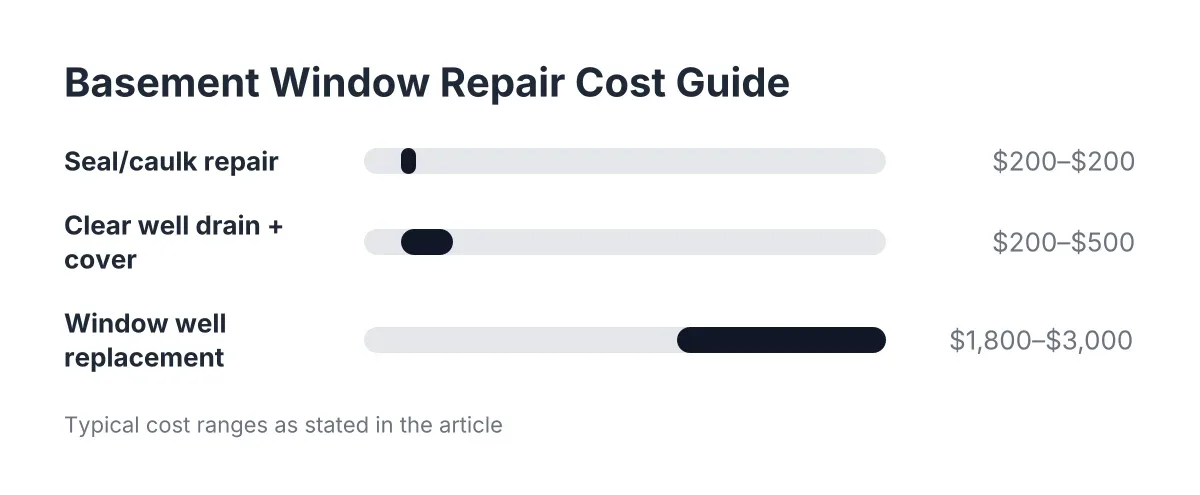
The cost question is the one every homeowner asks first, so here is the honest range. A drainage fix, such as clearing a well drain, extending a downspout, and resealing the frame, typically lands in the low hundreds. Replacing a standard basement window sits in the low thousands. Full egress work costs more, because it involves cutting concrete and installing a code-compliant well.
Verified national figures back this up. According to HomeAdvisor, window well replacement averages $2,200, with most homeowners spending between $1,800 and $3,000. For egress projects, Angi reports that egress window installation averages $4,244 nationwide, with most homeowners paying between $2,723 and $5,898 per window. Those numbers matter in Minneapolis, because egress code sets a real floor on the scope of work. According to HomeAdvisor, IRC egress code requires a well that projects at least 36 inches from the house with a nine-square-foot footprint and a window with a 5.7-square-foot net clear opening. In other words, you cannot legally shrink an egress opening to save money.
Our window leak repair cost guide breaks down exactly which factors push a job from one tier to the next, so read it before you collect quotes.
How to Pick the Right Local Contractor
When you search for window repair near me, you will find two kinds of results. Thin local listings offer a phone number and little else. Meanwhile, large regional contractors quote from a script, and their estimator may never have dug a window well in Minneapolis clay. Neither one is built to answer the question you actually have, which is what this specific leak will cost to fix for good.
Instead, look for a contractor who will talk specifics before asking for a signature. Ask how they handle the well drain, not just the window. Ask about frost depth and backfill, because a well set in poorly compacted soil will settle and leak again. Additionally, ask whether they install galvanized wells, which resist rust far longer than untreated steel in our climate. A straight answer to those questions tells you more than any review score. That is the standard we hold ourselves to, and it is the standard any search for window repair near me should end with.
Ready to Get Started?
If water is coming through a basement window right now, you do not need a sales pitch. You need someone who knows Minneapolis basements to look at the well, the drainage, and the window, and then give you a real number. Reach out, tell us what you are seeing, and we will give you a straight answer on whether this is a small fix or a replacement, and a clear quote either way.